.png)
The Hidden Grief of Moving Abroad: Why a "Better Life" Can Feel So Sad
Updated: Mar 20
A Psychologist’s Guide to Migratory Grief and the Path to Belonging
The Invisible Suitcase
You’ve secured the visa and found an apartment, perhaps you’ve even landed the dream job you spent months working towards. To the outside world, you have succeeded by making the brave leap that so many only talk about.
But in between unpacking boxes, building new routines, and navigating unknown streets, a heavy feeling settles in. Sadness that lingers, waiting around the corner of every happy moment. And with that sadness comes guilt. Guilt for not being grateful enough for the opportunities you have and finally getting to live the life you worked so hard to build.
"I moved for a better life. So why do I feel so sad?"
As a psychologist working with expats, and as someone who has built a life from scratch more than once abroad, this is the truth I’ve come to realize:
Choice does not cancel out loss.
The sadness you feel is not a sign of being ungrateful, or worse, a sign that you have made a mistake. It is simply a natural, human response to one of the most profound challenges of the migratory experience. Having chosen to move does not take away your right to grieve.

Image: Photography via Wix Media
A Silent Loss: What is Migratory Grief?
Migratory grief is a deep, multifaceted sense of loss experienced when leaving one’s familiar world behind. It is an accumulation of losses, from the loss of identity and status to the narrowing of communication possibilities, interpersonal (leaving behind friends and family) and even material losses (loss of a house and stable income).
When we talk about the emotional weight of moving, two reasons make this loss feel so much heavier:
Disenfranchised loss: As migration is often associated with opportunity, improvement, and the pursuit of a better life, it can make sadness feel unacceptable. The losses that come with migration are often losses that society fails to acknowledge and validate, creating pressure to hide our sadness behind a mask of gratitude.
The "mask of gratitude" leaves no safe space for our true experience to be named or explored, denying us the room we need for these conflicting emotions to coexist and be processed.
Ambiguous loss: Unlike other losses, the "objects" of your grief (your home, your friends, your culture) still exist but are simply out of reach. This ambiguity is what makes this loss feel so complex.
It is a partial loss, because you’ve lost essential elements (language, culture, social networks), but not your full life.
It is a recurrent loss, as the pain revisits, triggered by moments of nostalgia, encounters of prejudice, and difficulties in integrating.
It is a multifaceted loss, affecting many aspects of your life.

Image: Photography by Dr Eleftheria Koutsonika
Bringing in the Theory: The Two Sides of Grief
Understanding why we feel this way is one thing, but understanding how to live with it is another.
You might have a morning where you feel excited about navigating your new life, only to be hit by a wave of sadness by dinner time. You might ask yourself, “Why aren't I over it yet?” or why it feels like you're taking one step forward and two steps back.
In my work, I often bring in the Dual Process Model of Grief (Stroebe & Schut, 2010), a framework that helps show that this "swinging" isn’t a sign of being stuck, but rather the natural process of experiencing grief. According to this model, healing isn’t linear, but instead, we move back and forth between two modes of being:
Loss-Orientation: This is the space where you lean into the grief. You miss the people you left behind, you look at old photos, and you mourn the version of "you" that knew exactly where they belonged.
Restoration-Orientation: This is the space where you focus on "becoming." You are busy with the practicalities of your new life, learning the language, building your career, and making new friends.
The Power of Oscillation
The most important part of this theory is the concept of oscillation. Healing isn't about “getting over it” and leaving the loss behind. You don’t have to “get over” home to “get into” your new life. It is natural to oscillate between both.
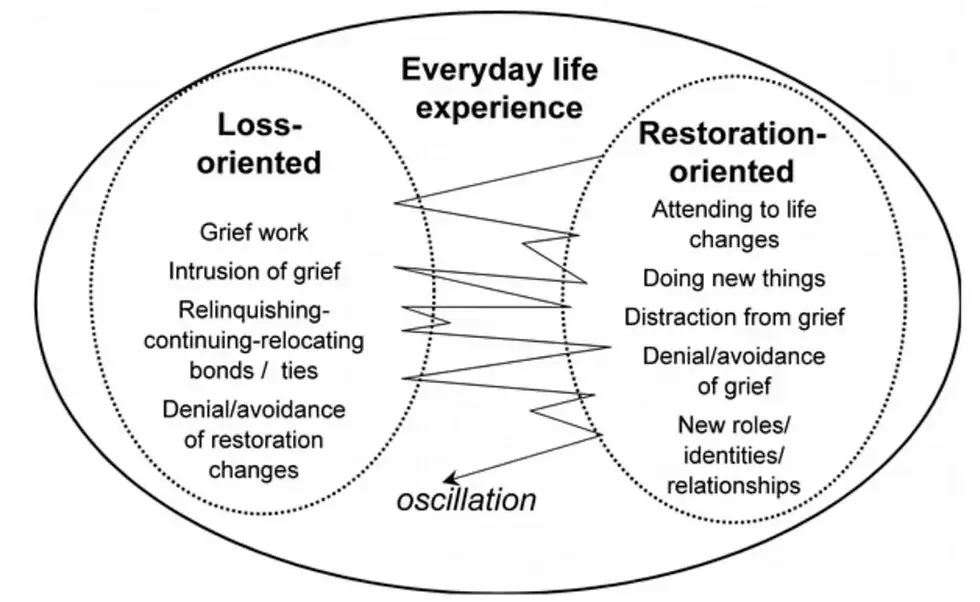
Diagram: The Dual Process Model of Coping with Bereavement (Stroebe & Schut, 1999)
Reclaiming the Narrative: Embracing the "Both/And"
We often live under the false assumption that happiness and sadness are rivals. But the reality of life is a "Both/And" experience.
You can be excited about your future and devastated by the loss of your past life at the exact same time.
Embracing this complexity is the first step toward integration. When you stop fighting the sadness, you free up the emotional energy you were using to "mask" it, allowing you to realize that:
It is natural to feel incredibly lonely in a city full of new people.
It is healthy to be proud of your new identity while mourning the versions of yourself you left back home.
You are allowed to love your new life and still feel like a stranger in it sometimes.
Finding your Balance
While there is no "quick fix" for the ache of migration, there are ways to be kinder to yourself as you navigate the space between who you were and who you are becoming:
Establish a Cultural Bridge: You might feel a silent pressure to "start over," but what our hearts need the most is continuity. Instead of forcing yourself to adapt to everything at once, bring a piece of "home" into your new space. It might be the specific way you brew tea, the spices that make your kitchen smell like your mother’s, or a traditional fabric draped over a chair. These aren't just objects but anchors; a reminder to your nervous system that you are still "you," even in this brand-new environment.
Migratory grief can feel like you are speaking a language no one around you understands
Find Spaces of Shared Understanding: Seeking out spaces where you don’t have to explain your heritage, your faith and your experience is vital. This might mean going to the mosque, church or synagogue, finding a community of fellow expat women who are pregnant, seeking out specialised expat psychological support or simply a space where you can speak and laugh in your native tongue. Whether it’s celebrating Ramadan, Diwali, Lunar New Year or Name Days, being in a space where your culture is understood gives you a precious sense of belonging while away from "home".
A Soft Space for Yourself: On days when the world feels too overwhelming, and you might feel out of place, give yourself permission to simply be. This is your "Home in a Pocket”: a movie in your native language, the music you grew up with, or a meal that tastes like childhood. Think of it as a warm hug for the version of you that is still adjusting. It’s okay to take a break and just be.
Therapeutic Support for Expats at Eria Therapy
The transition of moving abroad is a unique "in-between" state that can be difficult to navigate alone. As a counselling psychologist with both professional expertise and a personal understanding of starting a life from scratch abroad, I'd be honoured to walk alongside you.
Together, we can hold space to honour the losses that often go unnoticed and explore the shifting identity that emerges when you live across borders and between cultures. My goal is to help you cultivate a sense of home within yourself, one that stays with you no matter where you are.
Contact Eria Therapy to schedule a free consultation or ask any questions you may have.
References
Boss, P. (2006). Loss, trauma, and resilience: Therapeutic work with ambiguous loss. W. W. Norton & Company.
Stroebe, M., & Schut, H. (2010). The dual process model of coping with bereavement: a decade on. Omega, 61(4), 273–289.


Comments